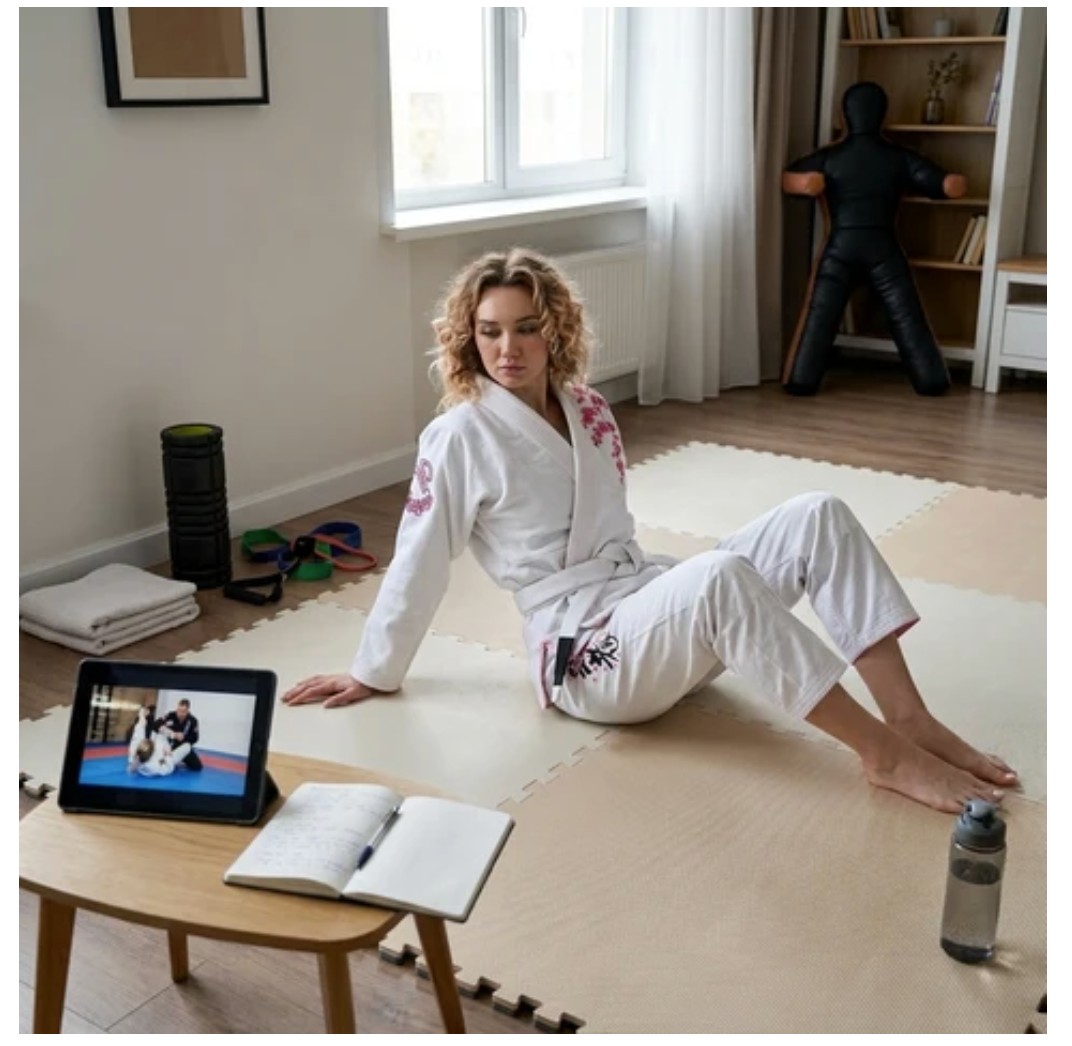
Besides undergoing surgery and utilizing knee rehabilitation equipment post-surgery, I have learned that I can also practice some basic stretching exercises regularly for a torn meniscus in the knee. Not only do I have a torn meniscus in my right knee, but I have one in my left knee as well.
Recently, I was introduced to a special type of conditioning. It is used in preparation for practicing a specific form of martial arts training: Jiu-Jitsu. My friend who facilitates this training is a concrete contractor. Several years ago, he was having a terrible time with his knees and could barely get around, let alone do his job effectively.
Around that time, a couple of guys he worked with noticed the pain he was experiencing as well as his mobility issues on the job site. They invited him to join their training classes to teach him the routine of exercises and stretching that goes along with the Jiu-Jitsu martial arts form. It worked so well that he now passes along and coaches this same routine to others for fun and for free.
What a blessing his training has been in my life because even after only a few weeks of practicing this, I can feel the pain slightly subsiding and my mobility increasing. Put it this way, I can go up the stairs like normal again instead of clutching the railing and pulling myself up each stair one foot at a time. Shoot, sometimes it would hurt so bad I would literally crawl up the stairs!
According to Healthline, “A meniscus tear is a common knee injury that often affects people who play contact sports. It can also be caused by wear and tear and doing everyday activities that put pressure on the knee joint, such as squatting to pick something up or getting in and out of a car.
This injury occurs when a person tears the protective cartilage in the knee.
Once you have your doctor’s approval to begin exercising, try some of these exercises to enhance your strength and stability following a meniscus tear.
1. Quadriceps setting
Quadriceps setting is an isometric exercise to strengthen the front thigh muscles.
2. Mini-squats
Mini-squats are another type of exercise that can strengthen the quadriceps.
3. Straight leg raise
This exercise both strengthens the quadriceps and stretches the hamstrings, or the muscles that run up the backs of your thighs.
4. Hamstring heel digs
This exercise works to strengthen the hamstrings and challenge the abdominal muscles.
5. Leg extensions
This exercise can be performed while seated, which means you can do it almost anywhere.
6. Standing heel raises
This exercise strengthens your gastrocnemius and soleus muscles, which together make up your calf muscles.
7. Clams
This exercise targets your hip abductors. It helps you strengthen your gluteus medius and gluteus minimus muscles.
8. Hamstring curls
This exercise strengthens the muscles on the backs of your thighs,”.
What is Jiu-Jitsu mostly about?
Each Saturday morning, from nine until eleven-ish, we start with a meditation period, then move on to stretching and exercises, ending with the last half hour mainly focused on breathing. Those who know me know that it must be working to get my butt out of bed early on a Saturday morning! The weekends are the days I usually get to sleep in.
Starting at noon, they begin Jiu-Jitsu training and grappling. My friend/coach has offered to train me in that area, too. Although I have two years of Tae-Kwon-Do experience and have always been fascinated with martial arts, the wrestling-style ground fighting Jiu-Jitsu practices is not my favorite.
The experts at Essential Jiu-Jitsu explain that, “The word ‘jiu jitsu’ derives from the Japanese ‘Jū’ meaning ‘gentle’ and ‘Jutsu’ meaning ‘art’; essentially, jiu jitsu is the ‘gentle art’.
…the origins of jiu jitsu are believed to go back thousands of years. There are several theories concerning its very first beginnings, but many agree that it can at least be traced back 4,000 years ago, to Buddhist monks in India, who needed to protect themselves during their travels without inflicting harm on their attackers. It then spread to feudal Japan, where it developed into an effective hand-to-hand combat during war, before transitioning to become more of an art form and a competitive activity. Some even argue for much older origins than India, dating back to the earliest forms of ‘grappling’, which are immortalized on the walls of ancient Greek and Egyptian ruins,”.
Most importantly, for my friend, it has made sense for his knee recovery process because, as mentioned by Essential Jiu-Jitsu, “Because jiu jitsu presents a combination of dynamic and explosive movements with pressure-based isometric pushing, pulling, and holding, it helps to develop increased strength and cardio, as well as promotes weight loss and improved muscle tone,”.
Jiu Jitsu workout at home
A few weeks ago, we did not have our Saturday morning training. Since we use a mixed martial arts studio, they occasionally have “belt testing,” and we cannot practice at our usual time. My friend sent a group text suggesting we practice at home until the following week, but I am new and do not know exactly what to practice yet.
Let’s see what the folks at Kingz suggest for practicing the technical stand-up drill at home, “Standing up from the ground isn’t about panic; it’s tactical. It’s a skill. The technical stand-up helps you disengage; it’s your exit strategy, keeping you balanced and protected.
What it is
BJJ technical stand-up drills show up after guard breaks, failed sweeps, or moments when distance is the smarter choice than forcing an exchange.
How to train it at home
Sit down. One hand posts behind you like a kickstand, the opposite foot flat and loaded. Keep the other leg light and ready. Lift your hips, slide that free leg back under you. Push through your hips, pull the leg through, and stand up. Reset and switch sides.
Speed doesn’t matter when practicing this BJJ solo drill; precision does.
Key focus
Keep your lead hand up with an open palm to protect your head. This habit helps in transitions and when creating space.
Common mistakes to avoid
Crossing your feet during the transition. Or, staring at the ground. Why? Because both mistakes wreck your balance. Eyes forward. Pretend your training partner’s still hunting, because in live rounds, they are!
A clean technical stand-up works as a reset that puts you back in control. You don’t just escape; you’re choosing when and how to re-engage,”.
Still waiting on my coach to send me a list of his special drills to work on at home!
Exercises for a torn meniscus in the knee
In conclusion, consistent, doctor-approved exercise and patient practice can strengthen the knees, improve mobility, and make everyday movement feel safer, easier, and more manageable again.