I have family who moved to North Carolina, adjusted to the southern way of life, and claim that they have better dunes than we have in Michigan. Ha! I beg to differ. Even though near their beach resort campground in the Outer Banks is Jockey’s Ridge State Park, with the tallest living sand dune system on the Atlantic coast, I do not think it’s better than what we have in Pure Michigan.
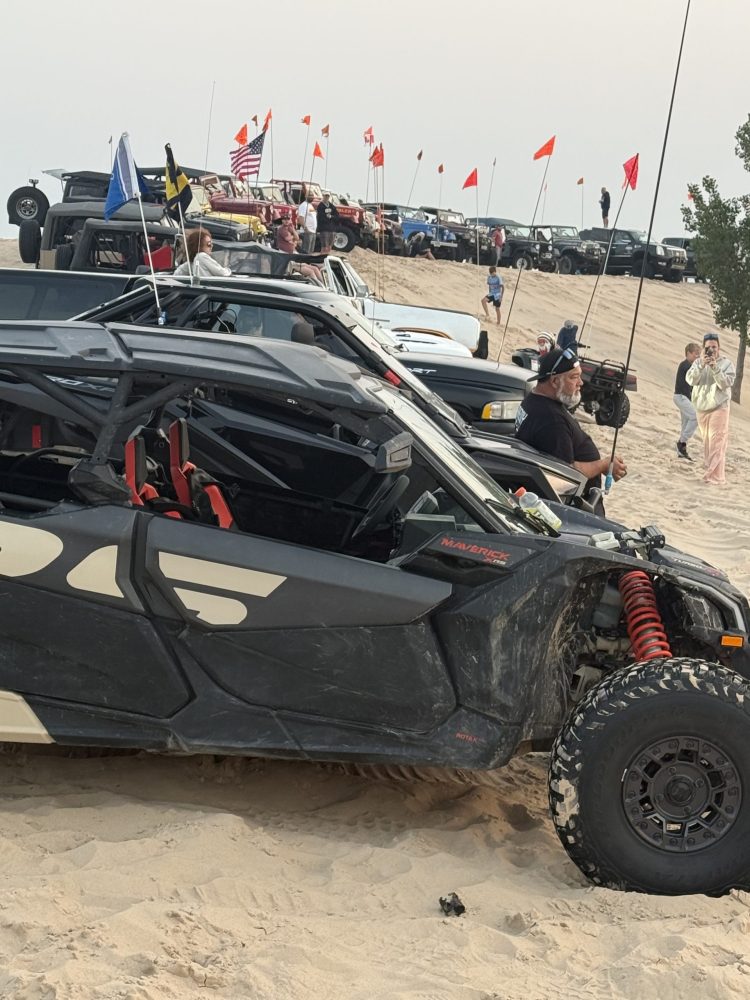
For example, next week I am going on a camping trip with my sons to Mears State Park, located on the shores of Lake Michigan and hosts many miles of walking dune areas. Up the road, about fifteen minutes, are the infamous Silver Lake Sand Dunes where ATV’s or other off-road vehicles try to conquer the sandy mountains. Shoot, I have seen everyday vehicles attempt to climb the dunes (and fail!)
Further up the coast, about an hour and forty-five minutes from Silver Lake are the pristine Sleeping Bear Dunes. In fact, there are dunes all along the west coast of Michigan!
Michigan Sand Dunes, according to the travel folks at Lake Michigan Destinations, “Our beaches are the best in the Midwest…in the Nation…in the world! Well, at least we think so, and so does ABC’s Good Morning America. The Sleeping Bear Dunes National Lakeshore in Northwest Michigan was voted by the viewers of GMA as the most beautiful place in America.
One of the spectacular sights at Sleeping Bear is the sand dunes that peak at over 400 feet. The largest dune system in the world associated with a freshwater lake is right here on Lake Michigan!
- The Sand Dunes of Central West Michigan
Silver Lake Sand Dunes
- Southwest Michigan Dunes
Saugatuck Dunes State Park
Warren Dunes State Park
- Northwest Michigan Sand Dunes
Sleeping Bear Dunes National Lakeshore
Ludington State Park & Hamlin Lake
Nordhouse Dunes Wilderness Area
Arcadia Dunes,”.
In the Upper Peninsula, there is another set of dunes at the Grand Sable Banks and Dunes in Munising.
On the east side of Michigan along the Au Sable River near Oscoda are large sand hills and dunes. I have had first-hand experience with these hills and dunes as we moved our annual camping trip over there after four years at Elberta Beach. When I was in my twenties, I could run up and down those dunes to swim with my dogs in the refreshing river waters. Yet, today, I wouldn’t even attempt it!
The Outbound notes that, “Hike atop 200 foot sand dunes overlooking miles of protected forest in the beautiful AuSable River Valley.
Lumberman’s Monument is truly a hidden gem. Most people don’t realize there are towering sand dunes in the Oscoda area. While the majority of visitors stay at the overlook, there is a breathtaking trail for the more adventurous.
For the brave, run down a dune and take a dip in the pristine clear water. In the summertime, you might encounter a few other boaters having a party on the edges of the dunes. Just remember, the climb back up can be strenuous!
After the last dune vista, the trail turns inland, and you can continue another 1.5 miles in the forest to Sawmill Point campground, if desired. If you make it to Sawmill Point, this is 2.8 miles from where you began,”.
What is dune grass?
No matter where we were camping – on the West Coast dunes or the East Coast river dunes, there was always that pesky dune grass to contend with!
When my cousin and I were about twenty years old, we started an annual Fourth of July camping trip with our friends and other cousins (as they became of age), with the first year at Ludington State Park.
When we, as a group of twenty-somethings, arrived at the campground around midnight, clinking and clanking as we set up our tents, the park manager came over to ask us to keep it down, as quiet hours were from 10 pm to 8 am.
He said we probably wouldn’t enjoy camping there because it was more of a family-friendly campground, and he let us in on a local-only secret about a secluded spot down the road from there where we could camp on the beach.
We took his suggestion and camped for free in tents on Elberta Beach in Frankfort, Michigan, on the shores of Lake Michigan. Albeit illegal camping, the campground manager told us that as long as we were respectful, took only pictures, and left only footprints, no one would give us a hard time for being there.
We all enjoyed it very much, except for when we stepped on the dune grass. It hurts like a mutha when you step on it, as the plugs are pokie and hard! The following year, we brought a weed whip to trim down the dune grass.
Before breaking out the weed whip, we ran into some forest rangers and asked if they minded if we cut down the dune grass. Good thing we asked first, because apparently it is a federal offense to do so, as the dune grass is protected!
What is the purpose of dune grass?
Thankfully, we did not cut any of that dune grass down on Elberta Beach or while camping in the Huron-Manistee National Forest along the Au Sable River, as there is a definite purpose for the dune grass.
The State of Michigan’s official government website declares that, “The Great Lake coastlines have extensive coastal dunes on Lakes Michigan and Superior. In the 1980’s it became apparent that development pressures had potential to impact the future of Michigan’s dunes as they became increasingly popular sites for recreation and residential development. In 1989, approximately 74,000 acres of dunes along 265 miles of coastline were identified as needing protection from developmental pressures and designated as Critical Dunes.
These Critical Dune Areas represent a diverse cross-section of dune shapes, height, and vegetation along Lake Michigan’s shoreline in the lower and upper peninsulas, and the shore of Lake Superior.
The Critical Dune Areas (CDAs) include public lands and private properties where developmental, silvicultural, and recreational activities are regulated and a permit is required under Part 353, Sand Dunes Protection and Management, of the NREPA. The law balances the benefits of protecting, preserving, restoring and enhancing the diversity, quality, functions, and value of the critical dunes with the benefits of economic development, multiple uses, and public access,”.
Michigan sand dunes ATV
In conclusion, Michigan’s dunes are more than gorgeous playgrounds—they’re living landscapes worth exploring, respecting, and protecting so future generations can enjoy them too.